


I called into the lab, which had a long corridor that opened into a reception area. Behind the reception desk stood a tall glass-fronted fridge where the film stock was displayed. I had just enquired about getting two rolls of 1600 ISO slide film, and Bill, the veteran lab owner, placed them gently on the counter.
“Grain like golf balls, but it will do the job,” he said, and continued, “It’s really a 400 ISO film designed for push processing two stops. Just make sure you nail the exposure because it’s very unforgiving at this extreme.”
Slide film was unforgiving at the best of times, but this Fujichrome 1600D was going to press that even further.
I took the two rolls of film in my hand and looked at them, then looked back up at Bill and said, “These, Bill, are going to document a relic of Hitler’s submarine navy. We’ve found a U-boat down in West Cork, but it’s deep and it’s dark.”
The following Saturday, we’d be heading to Union Hall, weather permitting.
Conditions were good on the day, and after striding into the water from Sundancer II, we drifted over towards the shot line buoy, my dive buddy and I exchanged nods, released the air from our buoyancy jackets and slipped beneath the surface. We oriented ourselves and began the descent—bottom time begins from the moment you leave the surface.
We had twelve minutes. The single 12-litre tank dictated everything—not enough gas to get into trouble, not enough time to overstay. The physics demanded discipline.
I carried a Nikon F90 in its Subal housing, a 16mm fisheye lens behind an 8-inch dome, and a single Nikon SB-104 underwater flash on a long arm. I was confident in both my diving and photography abilities, and optimistic about the Fujichrome 1600, though I’d never used it before.
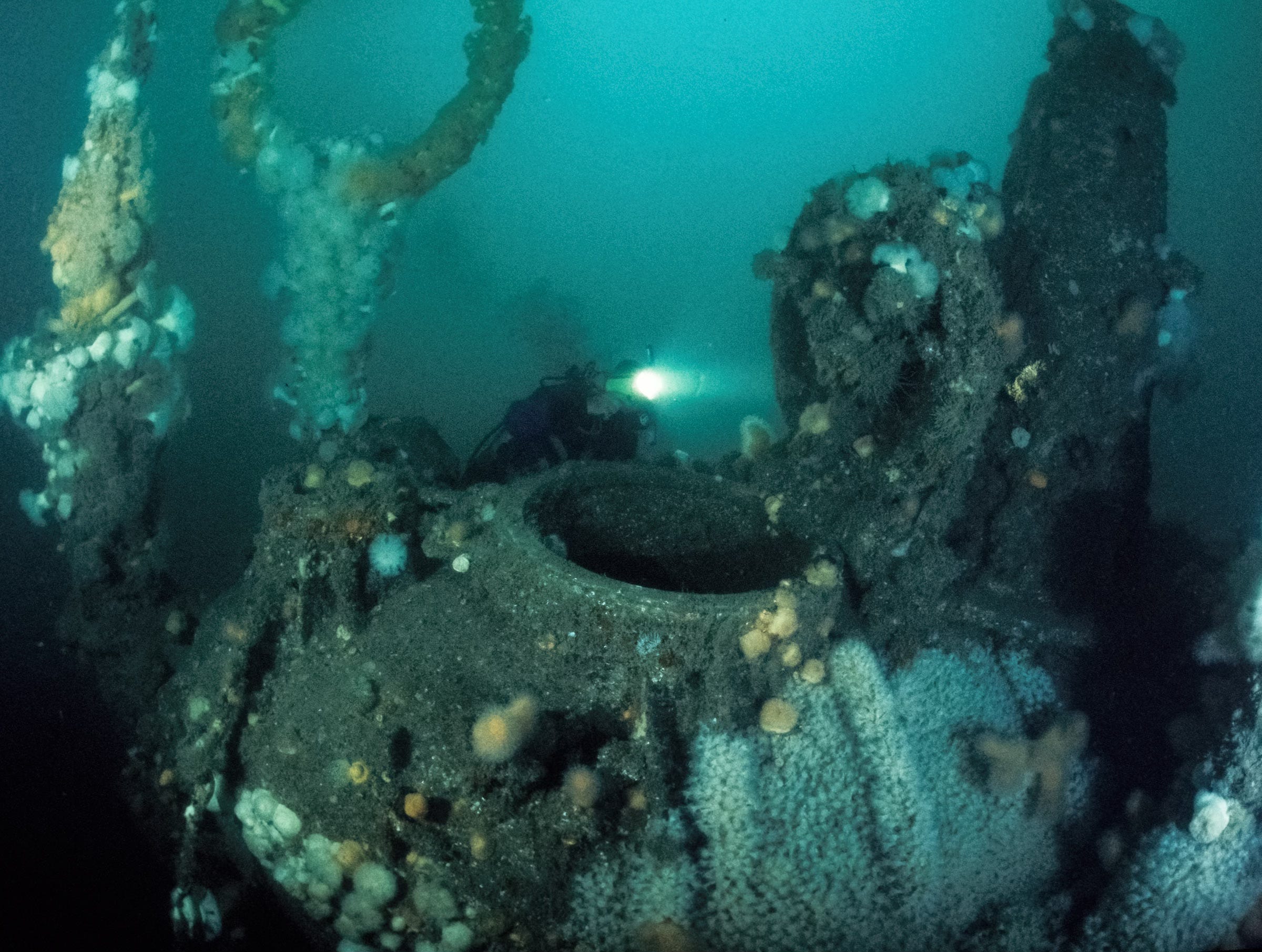
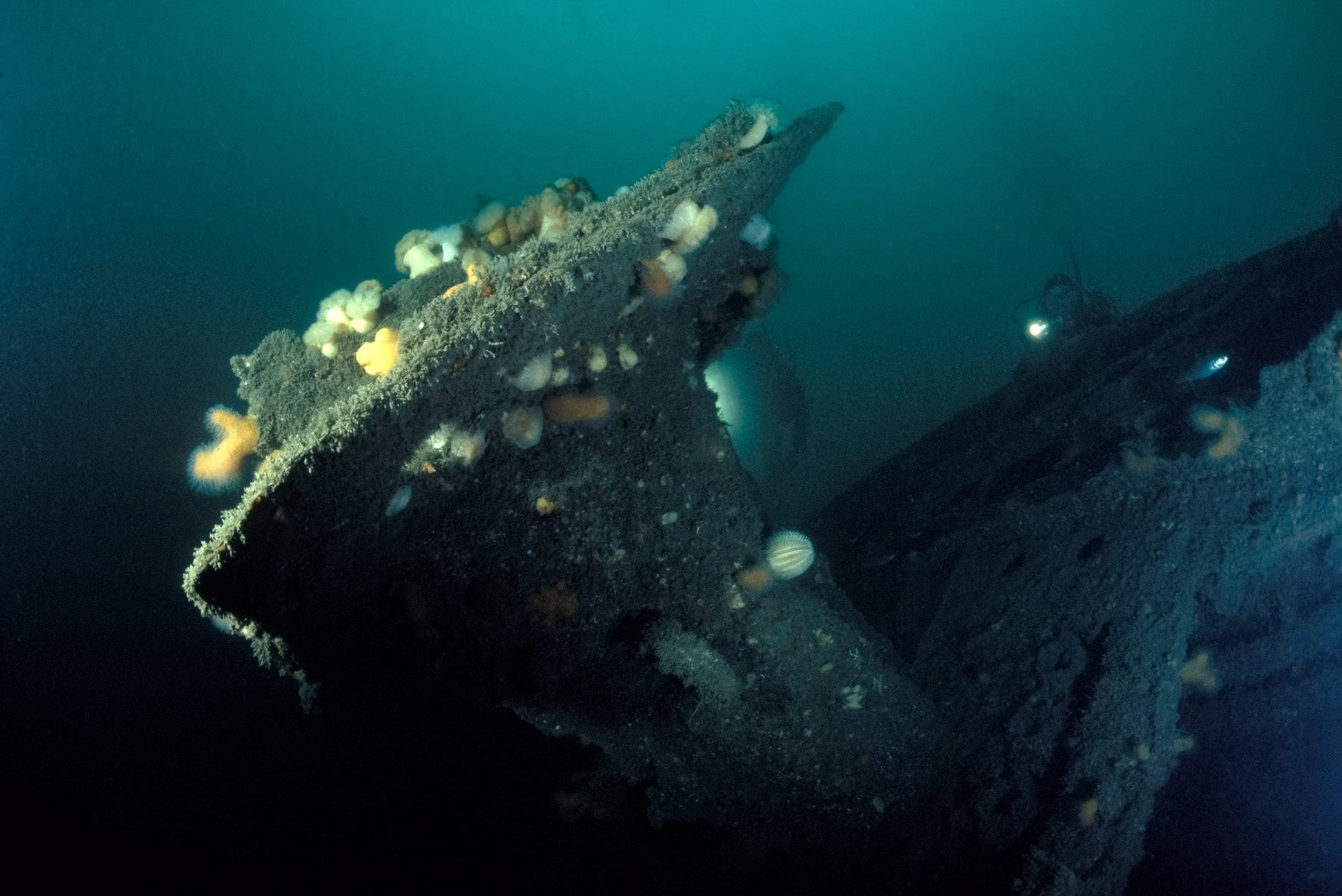
The rope disappeared into green darkness. At twenty metres the water turned murky, then cleared. At thirty metres I could feel the nitrogen beginning its work. The wreck emerged at thirty-five metres—the long cigar-shaped hull looming from the darkness. The shot line was positioned near the conning tower. Marine life had colonised every surface—anemones like ostrich plumes, dead man’s fingers swaying orange in the current.
My buddy stayed near the conning tower while I descended to the seabed, looking for an angle. The wreck lies notably over to one side, so I had to shimmy into the dark shadow beneath the tower to get the shot I wanted—looking up, dramatic, showing the open hatch with my buddy visible above.
I worked the single flash to light the scene of the tilted hull. Metridia, sponges, jewel anemones—all the small colourful life that encrusts metal. A large ling emerged briefly before retreating into shadow. The wreck wasn’t pretty—it was dark, commanding, a little spooky in its silence.
The open hatch stood there. I shone my dive light into the dark interior but could make little out. There was no going in—the thought terrified me. We’d never considered penetration. This was recreational diving at its limit, and we were careful.
Time to ascend. The long, slow climb to safety stop depth, where we’d breathe down the remaining gas conservatively.
When 35mm slide film was processed in those days, it was develop-only, cut into strips of six and placed in sleeves. At Colorfoto, there was a narrow light table opposite the reception desk where you could examine your transparencies with a loupe.
I tipped out the sleeved film and spread it out. Right away I could see we had an iconic shot of the conning tower.
“You better come see this, Bill.”
He came over, took the loupe, examined the image closely.
“That pushed film worked,” he said quietly. “You’ve got your shot.”
March 12th, 1945—Galley Head
The historical narrative that follows draws from Paddy O’Sullivan’s research. His 1999 article for the Ardfield/Rathbarry Journal was substantially cut in publication. What follows uses his published account.
The twelfth day of March 1945 was just another routine day for the lighthouse keepers and their families at Galley Head. The storm of previous days had calmed, and the howling wind had dropped to a south-westerly whisper—only the wailing of the gulls interrupted the stillness. That evening saw a scarlet sun set amid fiery clouds. The moonless night that followed brought total darkness to the landscape.
The remote quietness of this rocky headland contrasted sharply with the inferno of war raging in Europe. Germany’s armies were retreating on all fronts and Hitler’s dream of a Third Reich was collapsing in the blood-drenched rubble of the Second World War. Ten weeks later the Führer’s Berlin would be crushed in a storm of blood and fire as Russian T-52 tanks rumbled into the heart of the Reich capital. Towards the end, Hitler would brood for days in his bunker before ending Germany’s war and his own life by his suicide on 30th April 1945.
Meanwhile at Galley Head, lighthouse keepers Sam Glanville and his assistant keeper, Joe O’Byrne, tended to their daily duties. Joe’s one-month-old infant, Teresa, was restless in her cot and would not settle for sleep. Joe’s wife, Peggy, fussed about the kitchen tidying up some odds and ends to the accompaniment of a confused moth flopping clumsily around the paraffin lamp.
Soon most would be in bed, barring the watchkeeper, who would tend to the lighthouse lamp into the early hours of the 13th.
Suddenly a sound like popping champagne corks disturbed the night as two dazzling flares fizzed skywards—moments later their spent cartridges landed in the lighthouse yard.
Within minutes both households were awake with keepers and nearby coast-watchers picking their way down the treacherous slopes to investigate the source of the flares. To their astonishment they discovered that sailors from Hitler’s navy had been shipwrecked on the high seas and had somehow drifted ashore, having floated for hours in rubber dinghies.
In total, forty-eight sailors were swept eastwards on the flood tide—eleven managed to clamber onto the rocks at Galley Head. The rest were swept further east to be picked up later by the Courtmacsherry lifeboat.
The Kitchen at Galley Head
The Galley Head contingent of sailors were led up the cliff and soon found themselves in the warmth of Joe O’Byrne’s kitchen—most crowded around the turf-fuelled stove to warm their chilled hands. Some handed over gifts of tinned cigarettes and dried beef to their hosts—one gave a Dutch silver coin to Peggy O’Byrne as a memento of his visit. Meanwhile the captain, Klaus Becker, busied himself burning his ship’s papers in the stove.
Soon the kettle was boiling and welcome cups of scalding tea were served to the bone-chilled mariners—cigarettes were lit up as the Germans relaxed to tell their tale.
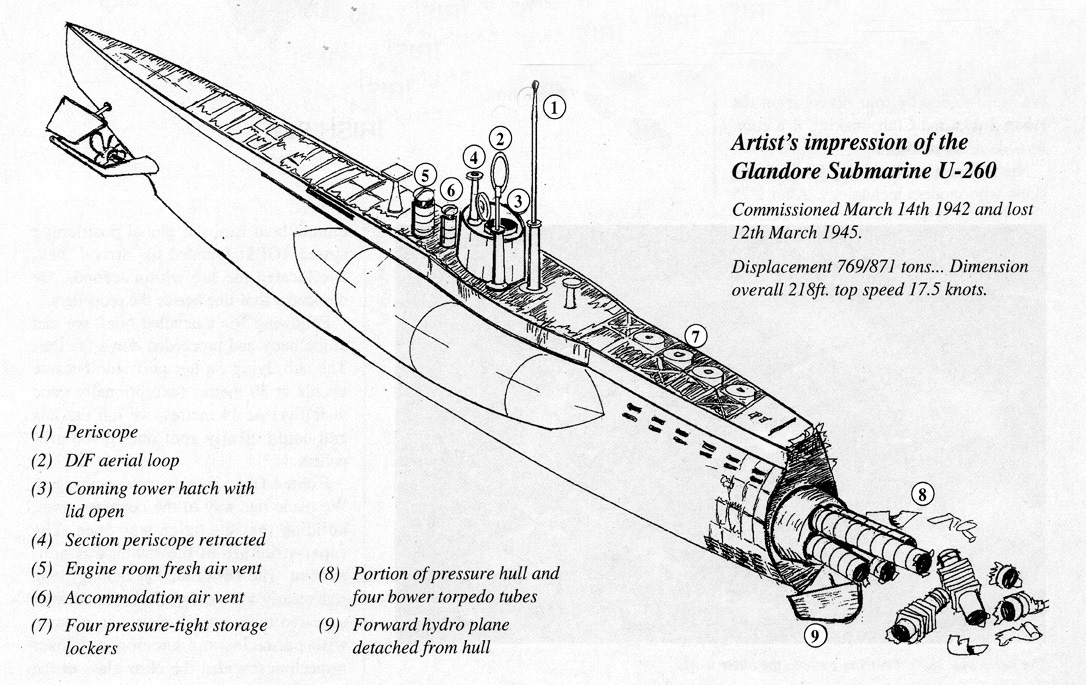
Their lost vessel was none other than the submarine U-260, a Type VIIC class. Oberleutnant Klaus Becker had departed from Kristiansand in Norway in February of 1945, pointing the iron snout of his submarine westward for operations in the English Channel—he had received specific orders to maraud off Southampton.
Within weeks he found himself patrolling in bad weather about twenty miles south of the Fastnet—visibility was poor and rain was relentless. Suddenly a deafening explosion rocked his submarine and plunged the vessel into utter darkness as the lights flashed out. Immediately the hull pitched to a severe angle and plunged out of control to the unknown depths as seawater cascaded into the submarine through damaged pipes and ruptured seams in the forward torpedo room.
The crew, paralysed by fear, realised that unless their downward plunge could somehow be arrested they would soon be crushed to death by the ever-increasing pressure. Klaus Becker attributed his misfortune to a mine and knew he could not continue the death-plunge or his submarine would soon become an iron coffin for himself and his crew members.
There was no choice but to order all ballast tanks blown and take what chance there was on the surface.
As high-pressure air hissed into the ballast tanks, the hand on the depth indicator mercifully slowed to a halt and began to back-track—now they knew they were headed for the surface. The frantic engineers could not control the ascent as they discovered that their forward hydroplanes and diving gear had been disabled by the mine explosion—the submarine shot to the surface and almost leapt out of the water in a whoosh of bubbles and foaming froth.
The Chlorine Gas Threat
As repairs continued, Captain Becker realised the full extent of the damage his craft had suffered and radioed a report to The Commander-in-Chief of Submarines in Germany. Soon he would make a second frantic call to report that his craft was now unmanageable. Salt water leaking through its damaged seams might soon reach the batteries and mix with the battery acid to generate deadly chlorine gas.
Nothing strikes greater terror into the heart of a submariner than the thought of being trapped in an iron hull with acrid chlorine gas seeping from the battery compartment. Two or three whiffs is enough to set the lungs bleeding and throat burning with unbearable torment—no death is more agonising than that from chlorine gas.
Berlin responded by ordering him to abandon ship after he had opened its sea cocks to sink the vessel—the German Admiralty had no intention of seeing their submarine fall into enemy hands.
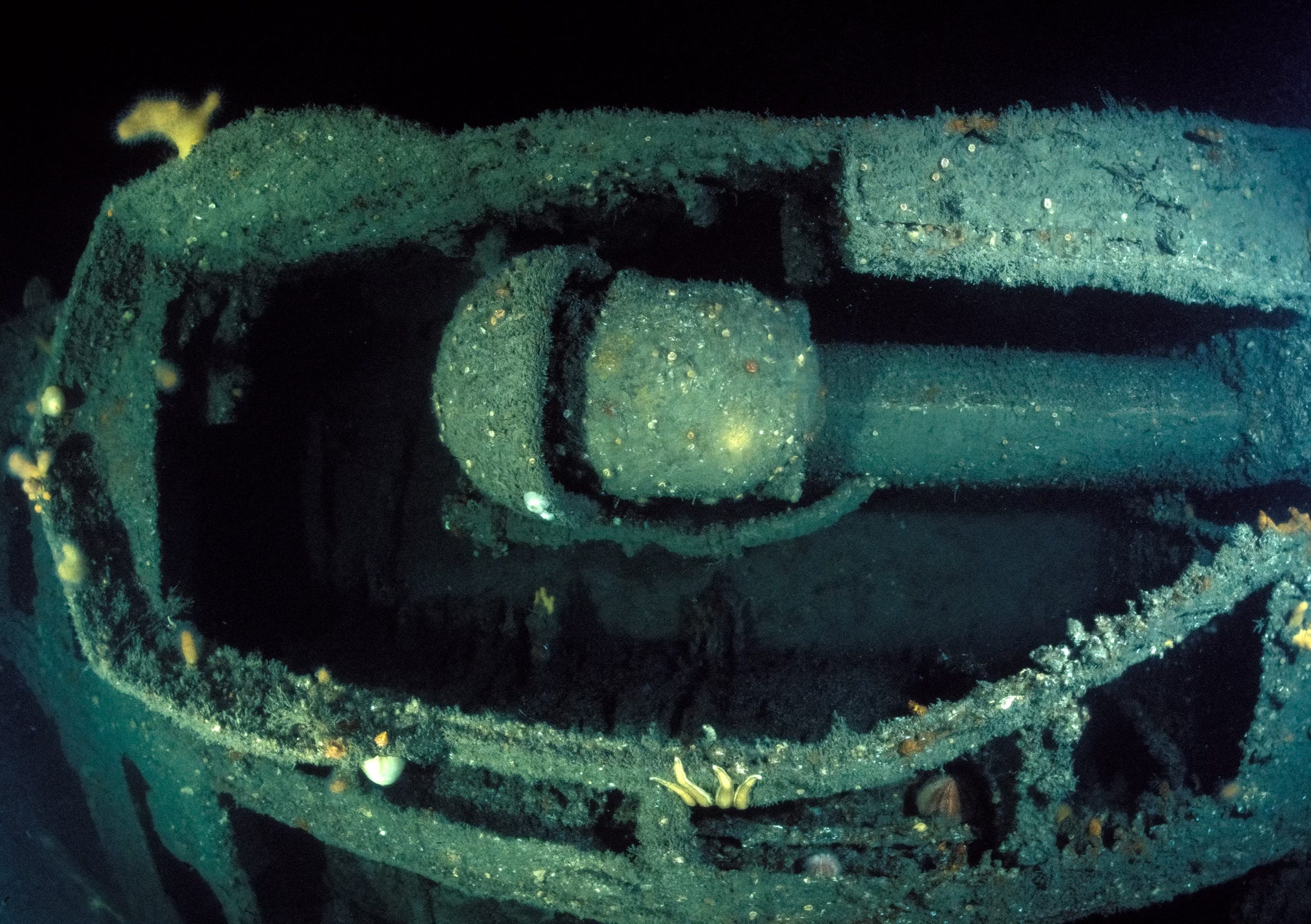
Fortunately for the crew, no British warships appeared and evacuation took place in an orderly fashion. Inflatable dinghies were stored in large watertight lockers outside the pressure hull of the submarine. All forty-eight submariners took to the dinghies—all were young, some barely in their teens. The eldest could boast a ripe old age of twenty-three.
Hitler’s Navy of youngsters were about to sample life on the Emerald Isle.
The Curragh
The strange visitors to Galley Head departed almost as suddenly as they had arrived. Early next morning the authorities arrived at the lighthouse to whisk them off to the Curragh and internment—on arrival at Kildare they were once again united with their colleagues from the Courtmacsherry rescue.
Ireland was then a poor nation and conditions and food at the Curragh were anything but rosy for the Teutonic internees. However, the fare proved far better than those that prevailed in starving Germany and the natives were friendly. The internees were given daily wages. Some even took up part-time work cutting turf in the bogs of Kildare—the authorities obligingly looked the other way.
All forty-eight had survived. In a war where approximately 30,000 of the 40,000 men who served in U-boats died—a casualty rate unmatched in modern warfare—U-260’s entire crew lived through their operational career and their final crisis. The submarine never killed anyone. Not in its wolf pack operations, not in its death.
The Boat’s War
The U-260’s career spanned but three years since its construction in 1942 at the German shipyard of Vegesacker Werft. The submarine was captained by Herbertus Purkhold on its first five transatlantic voyages. On a December 1943 patrol, the U-260 formed part of a dreaded wolf pack in company of U-591, U-225, U-406 and U-356. This formidable force attacked convoy number ONS-154 and torpedoed and sank fourteen of its ships to the loss of only one of its own submarines, U-356.
Two weeks into his patrol Captain Purkhold encountered a violent hurricane which he recorded in his log:
“Wind force 11, south-west hurricane, while trying to run before the storm at full speed the boat dived twice with hatch open. By blowing tanks and putting my helm over, and reducing speed, I managed to hold her reasonably well on the surface. To remain on the bridge was impossible. Within half an hour the Captain and the watch were half drowned. Five tons of water poured into the boat in no time, through the conning tower hatch, the voice pipe and the diesel ventilating shaft.”
During this storm, Purkhold observed that one ship rolled over and sank with all hands due to the severity of conditions.
Purkhold was later replaced by Oberleutnant Klaus Becker as Captain of U-260. Under its new commander the submarine made two patrols to the Bay of Biscay before being transferred to Norway for modifications in September 1944. The U-260 was fitted with her snorkel in August 1944 just prior to her eighth wartime patrol—the first practical and commercially viable snorkel system, developed by Hellmuth Walter. This device allowed submarines to run underwater on their diesel engines by breathing fresh air through a long tube that extended above the water.
A submerged U-boat travelling on its diesels could not be detected by the enemy and the snorkel protruding over water could easily have its reflective qualities eliminated, thus making it invisible to all-seeing enemy radar. The innovation came too late to affect the war’s outcome
Discovery
The wreck site of U-260 was discovered in 1975 by local fisherman Colin Barnes after he lost some gear—he suspected it had snagged on wreckage and duly noted the position. For a time, it was presumed that this could be the wreck of the cargo ship Counsellor (which sank in 1917), but a subsequent inspection dive by Joe Barry, Barnes’ diving friend, established that the wreck was a submarine, not the expected cargo ship.
By the mid-1990s, a steady stream of enthusiasts made their way to Union Hall, gear loaded for deep water and cold. At the helm was Nic Gotto, skipper of Sundancer II. He knew the site as well as anyone, ferrying groups out four miles past High Island, out to the edge where history rested.
For many, Nic’s boat was the gateway. He gave access to the relic—a piece of Europe’s unfinished business, lying quietly on the seabed. The stream soon swelled as curious divers from all over the world flocked to see the German submarine—all agreed it was a most fascinating experience to visit what is now generally regarded as one of the world’s most intact U-boat wrecks.
Sadly, Nic Gotto lost his life to the sport he loved so much on 24th July 1998. Nic died as a result of a diving accident off the Stags rocks outside Glandore. He is sadly missed by all who knew him, especially his countless friends in the diving world.
What Remains
Paddy O’Sullivan, who researched the U-260’s history for years, described what remains of the wreck this way:
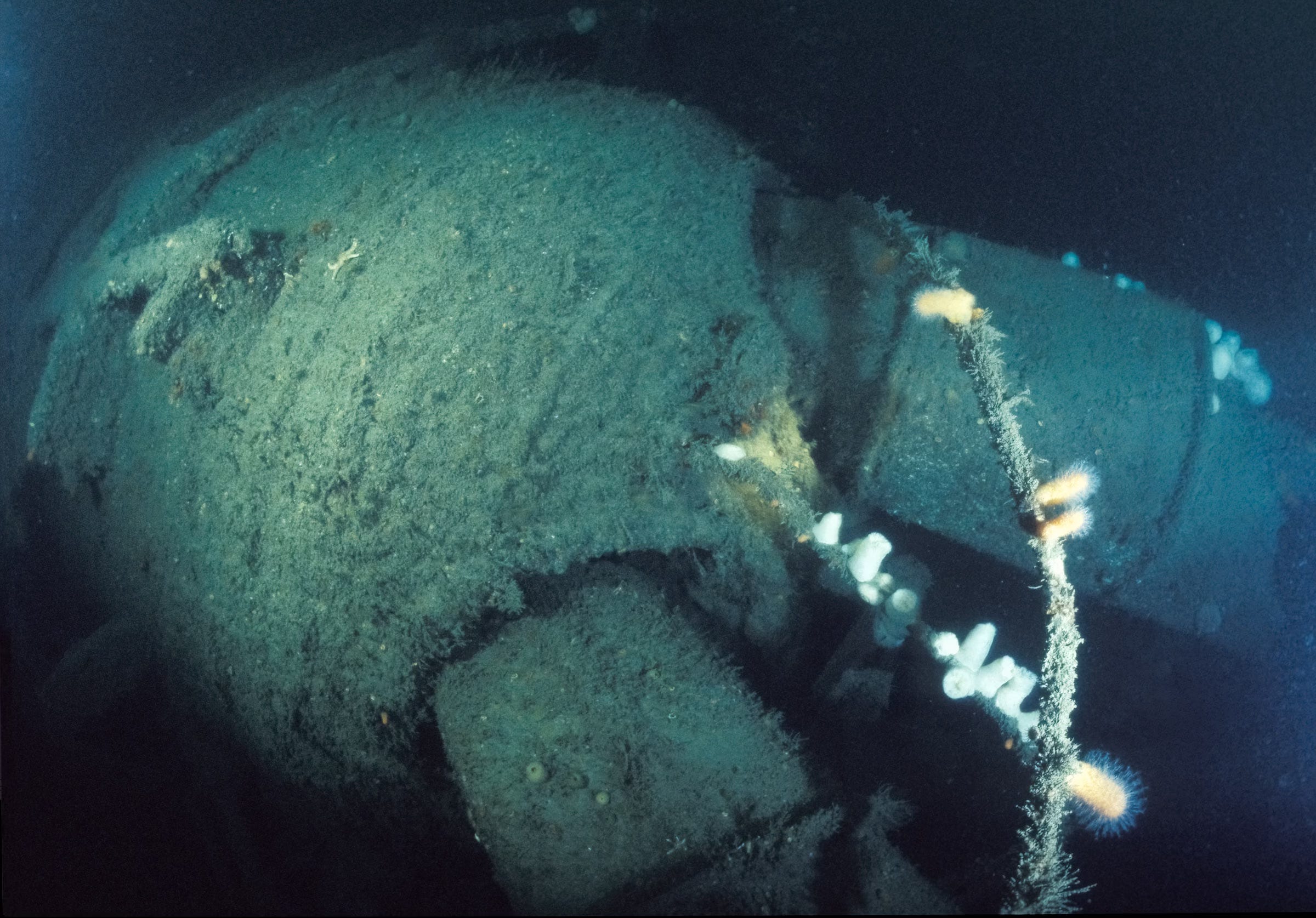
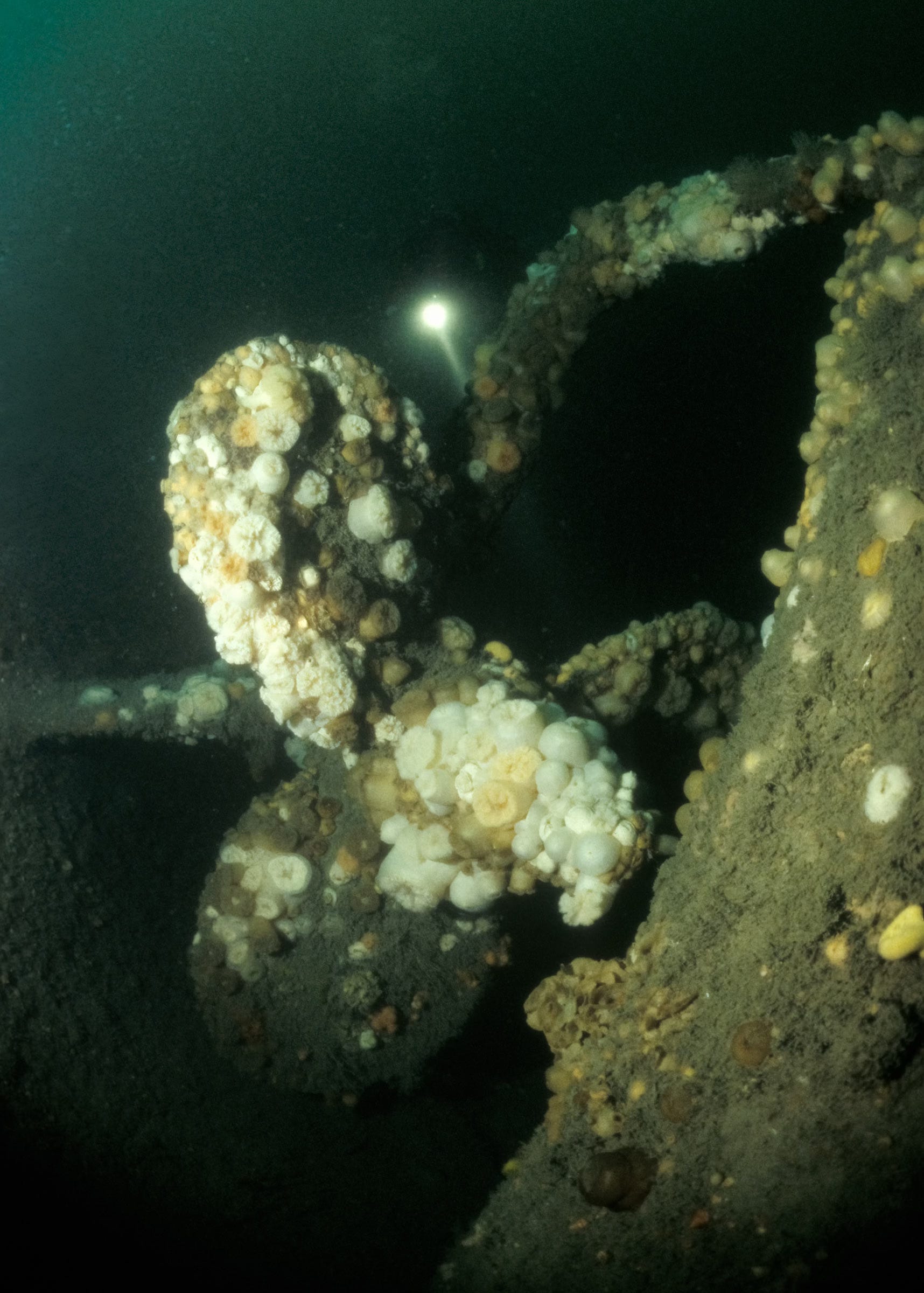
Today the U-260 lies in dim greenish light on a rocky sea floor, the seabed at forty-two to forty-six metres depending on the tide. Its conning tower is colonised by marine organisms such as stalked Metridia and anemones interspersed with bright orange-coloured dead man’s fingers which sway in the currents as if to beckon divers closer.
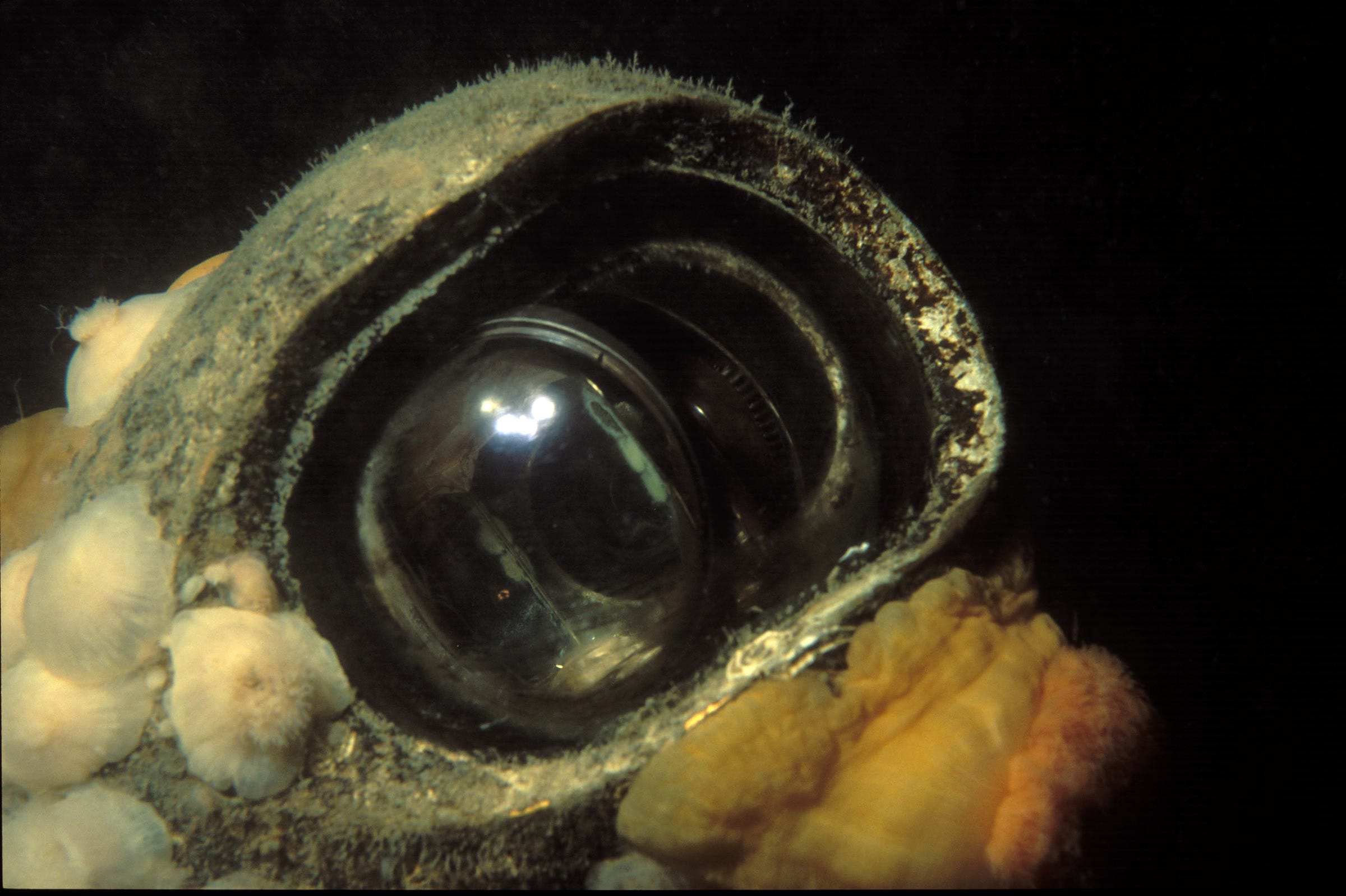
The attack periscope with its cyclops eye is extended as if scouting the horizon. The integrity of the periscope has not been compromised by more than half a century of immersion in the chilly Atlantic off Glandore. Its orange-sized lens is still watertight and, peering through it, one can see precision brass gears linked to prisms and focusing lenses.
On the port side adjacent to the conning tower, Walter’s snorkel is neatly hinged flush with the deck. As one swims towards the bow the graceful cigar-shaped contours end in a confusion of torn scrap iron and dangling torpedo tubes—no doubt the damage wrought by the mine explosion that sent it plunging to eternity in 1945.
The wreck continues to stir the imagination, though she will never return to Wilhelmshaven to replenish her fuel or supplies. Her death-dealing torpedoes will never be fired in anger to ravage Allied convoys—her electric motors that once hummed as they provided welcome warmth to chilled hands of crew members are now cold and silent.
Her once-gleaming Mann-Diesel engines are now blanketed in silt and entombed in an engine room of perpetual darkness. Her snorkel and periscope bear mute testament to the genius of men like Walter and Zeiss.
Her rusting hull will stare for eternity at a desolate landscape—a reminder of a war that achieved little more than the slaughter of millions of lives and the destruction of towns and cities on an unprecedented scale.
I haven’t been back. The work was done in those twelve minutes—Paddy’s history documented in images, a survival story captured. Nic continued taking divers to the wreck until his death in 1998, opening access to history for countless others. The wreck sits there still, over forty metres down off Glandore, waiting for the next diver to descend into the green. But my relationship with U-260 is complete. Sometimes twelve minutes is all you need.
AUTHOR’S NOTE:
The historical narrative for this essay draws substantially from the research and writing of Paddy O’Sullivan (Patrick O’Sullivan), whose years-long work with German naval archives and contact with surviving U-260 crew members provided details no other source could offer. These articles appeared in SubSea Magazine (December 1996) and the Rathbarry-Ardfield Journal (August 1999), among others. The photographs mentioned were published in SubSea Magazine (Autumn 1996), Technology Ireland (October 1996), and DIVER Magazine (July 1997).