


'In these northern waters, time is measured differently. Not by clocks or calendars but by the eternal rhythm of tides. The First Nations peoples of these shores understood this - how the waters would surge and retreat, how they would tremble the very foundations of islands, how they would dictate the patterns of all life. To truly know these waters is to learn this ancient wisdom.'
- Chief Dan George, Tsleil-Waututh Nation, 1967
The ancient cedars loom through ribbons of morning fog, their shadows gradually revealing the bones of the British Columbia coastline. After twenty years, I have returned to these northern waters, drawn back to explore the diverse marine life and dramatic underwater landscapes of Vancouver Island. The waters here were the inspiration for my first book, Cool Waters Emerald Seas, born from a journey aboard the Nautilus Explorer in 2004 when we circumnavigated the island, exploring its diverse underwater realms. That trip revealed the extraordinary nature of these northern waters - from the pristine walls of Browning Pass to the rich marine life of Rock of Life. Yet Nakwakto Rapids, one of the planet's most challenging cold water dive sites, remained unknown to me then - its existence and remarkable nature revealed only on this return trip when our skipper described planning our entire week's diving schedule around a single slack tide window. Each day leading up to Thursday's planned attempt, we consulted weather reports and discussed conditions with the boat's captain, hoping circumstances would align for this dive I had only just learned about but now could hardly wait to experience.
Our skipper reduces speed as we enter Seymour Inlet, the landscape closing in around us. Ancient cedars and spruce grip the steep shoreline, their branches draped with pale green Usnea lichen that seems to glow in the filtered morning light. These forest-clad walls rise nearly 3,000 feet from waters that plunge 700 feet deep, creating a fjord-like passage that channels both water and history through its narrow confines. Looking at the quiet shoreline now, it's hard to imagine that less than sixty years ago, this inlet supported thriving Indigenous communities, their lives attuned to the rhythms of tide and season that had sustained their ancestors for millennia.
The skipper, noting my gaze toward a distant shoreline to the north, speaks quietly. "The Gwa'sala-'Nakwaxda'xw band of native people lived here until '64," he says, letting the date hang in the air. "Government moved everyone to Tsulquate reserve near Port Hardy." His words carry the weight of a tragedy still raw in living memory. In that summer of 1964, these proud people - distinct from but often confused with the Kwakiutl (Kwagu'ł) of Fort Rupert - were forcibly relocated from their traditional territories. The waters we traverse were once their highways and hunting grounds, the forests their gardens and gathering places. When officials burned their homes to prevent return, centuries of connection to place were severed, leaving only empty shores and memories. The tides that once guided their seasonal movements still pulse through these channels with ancient power.
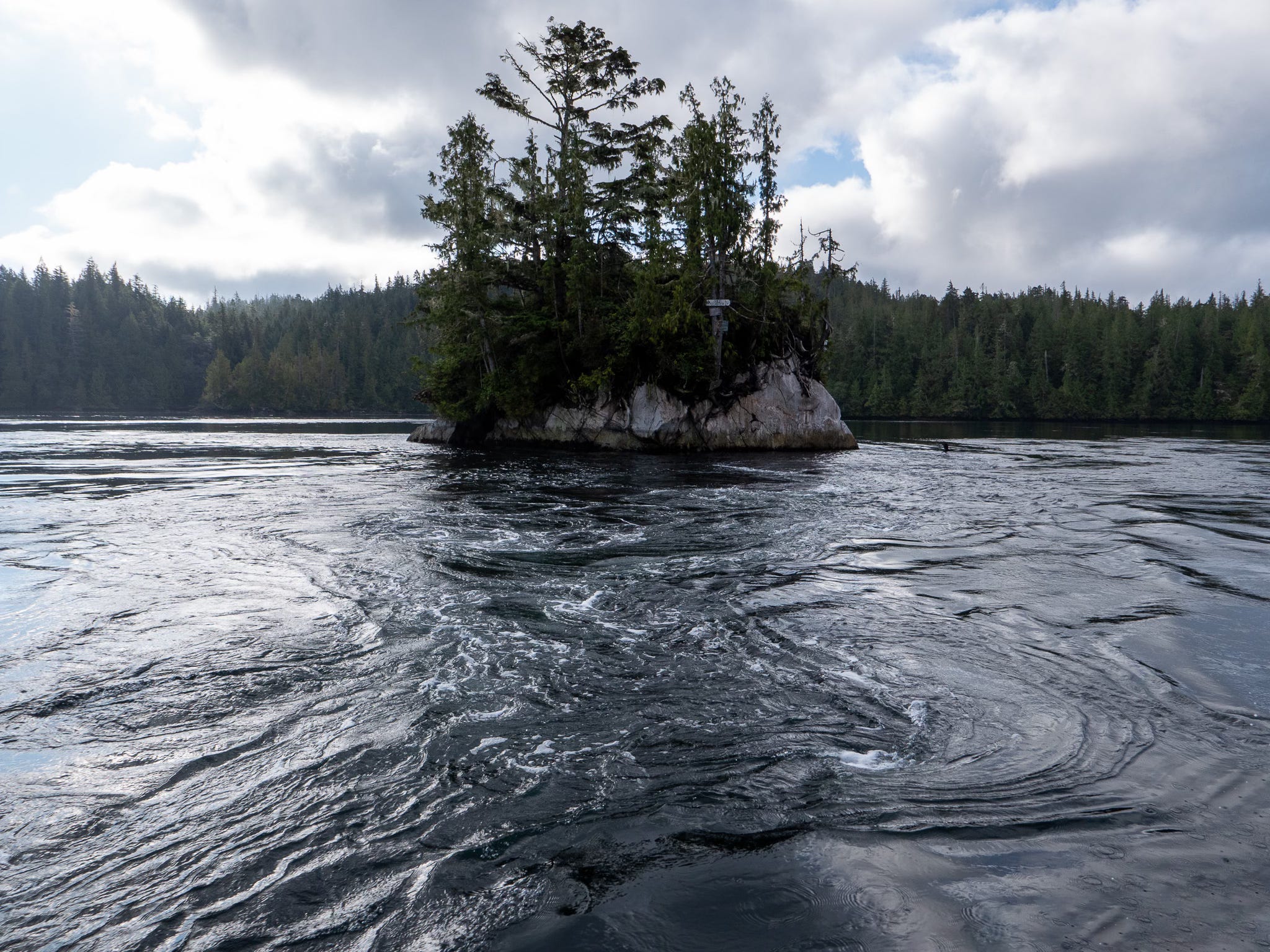
Our motion changes as we enter the approach to Nakwakto Rapids. Here, multiple inlets funnel through a passage barely 400 meters wide, creating one of the planet's most powerful tidal flows. At its peak, currents can reach 14.5 knots - faster than most boats can power against. Even now, approaching slack tide, we can see the water's surface betraying the forces beneath, small whirlpools appearing and vanishing like spirits.
At the heart of this maelstrom sits Turret Rock, known locally as Tremble Island. The Gwa'sala-'Nakwaxda'xw people named it thus, saying the island itself would shake when the waters reached their full fury. Science now confirms what traditional knowledge long knew - these are among the fastest tidal rapids on Earth, moving nearly four billion cubic feet of water with each exchange. The forces that make this place so challenging for divers have also created something extraordinary beneath the surface - a unique community of marine life found almost nowhere else on the planet.
The preparation for diving Nakwakto demands a peculiar combination of patience and urgency. While we wait for the precise moment of slack tide, every piece of equipment must be methodically checked and secured. The skipper has planned this day for months, calculating the brief window when the rapids' fury will ease enough to allow safe entry. Even now, an hour before slack, the water moves with such power that bull kelp stands horizontal, like pennants in a gale.
"Maybe twenty minutes of diveable time today," our skipper advises, studying charts that show the complex interplay of multiple tidal streams. The skipper studies his tide tables meticulously. In these waters, timing defines the narrow margin between possibility and impossibility.
I leave my underwater camera behind without hesitation. This first dive in Nakwakto deserves undivided attention, a chance to simply experience these remarkable waters. If fortune grants another visit, I'll know what photographic possibilities await. My buddies and I perform our final equipment checks as the boat maneuvers into the lee of Turret Rock. The water temperature shows 9°C on our computers - cold enough to demand respect, but typical for these northern waters.
Our entry is cautious but deliberate. Even in the relative shelter of the island, the water holds latent energy, like a runner catching breath between sprints. Descending through emerald waters, the first thing that strikes me is the density of life clinging to every surface. The rocks are transformed into living tapestries by countless red gooseneck barnacles, their translucent stalks glowing with hemoglobin-rich blood. Unlike their black-pigmented cousins in the shallows, these deep-water variants display their internal chemistry openly, creating a submarine landscape that seems almost artificial in its vibrancy.
Among the barnacles, feather-duster worms extend their spiral crowns like living flowers, each one a miracle of natural engineering. Their tentacled heads, resembling Victorian chimney sweeps' brushes, filter the nutrient-rich waters swirling past. Everything here is adapted to not just survive but thrive in conditions that would tear less specialized creatures away.
We fin carefully toward the channel's edge, watching the bull kelp for signs of current strength. Earlier, these giant algae streamed out like flags in a gale; now they hang almost vertically, marking our brief window of opportunity. The rock faces beyond the kelp forest reveal even more spectacular congregations of life. Every surface hosts competing colonies of creatures, each adapted to harness the energy of the rapids. Jewel anemones create patches of living color that would humble any artist's palette, while red soft corals pulse gently in the dying current.
As we move through these waters, I reflect on how this place has drawn me back. Twenty years ago, photographing the vibrant life of Vancouver Island's waters, I couldn't have known how those images would lead to a book, or how that book would lead me back here. Now, without my camera, I find myself seeing these waters differently - not through a viewfinder, but with the direct wonder of a first-time visitor.
The forty minutes we spend in Nakwakto's embrace pass with the peculiar time-shift that divers know well. Each moment demands complete presence - monitoring the kelp's movement, checking our position relative to Turret Rock, watching our computers. Yet simultaneously, the dive feels suspended in time, as if we've entered one of those rare slack periods in life itself, when past and present flow together like mixing currents.
Our ascent comes as the first pulse of the returning tide makes itself known - a subtle but unmistakable shift in the water's energy. Breaking the surface in the lee of Tremble Island, we find ourselves momentarily wordless. The skipper's knowing grin asks the question that takes us several moments to answer. How do you describe a dive that represents not just the culmination of twenty years' anticipation, but a return to waters that shaped your understanding of what cold water diving could be?
Later, as our boat turns south toward Port Hardy, I watch Turret Rock recede into the fog that's returned to cloak the shoreline. These waters have witnessed so much - the traditional lives of the Gwa'sala-'Nakwaxda'xw people, their forced departure, and now the slow process of reconciliation. The unique creatures that thrive in these rapids - the blood-red barnacles, the feather-duster worms, the tenacious bull kelp - have their own story of adaptation and survival to tell.
My journey with these waters began in 2004, leading to words and images that attempted to capture the essence of cold water diving. Twenty years later, experiencing Nakwakto without a camera has revealed something deeper: how some places demand more than documentation. They require us to simply be present, to witness their power and beauty directly, and to acknowledge both the natural and human histories that flow through them like the eternal tides.