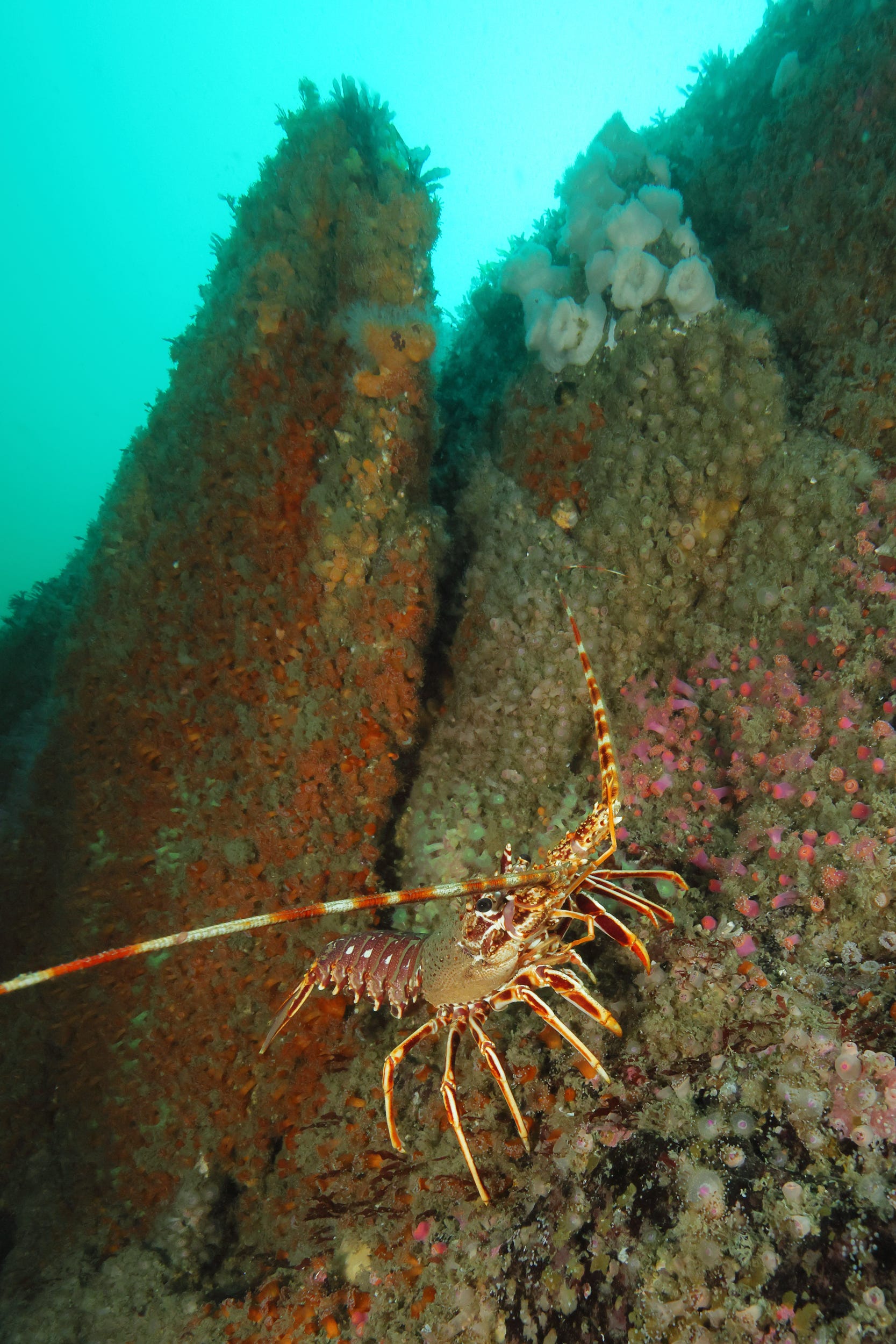
The invitation came at short notice, the way it always does. A midsummer window of fair weather had opened up, the forecast holding just long enough, and word went round: the Lings, Tuesday evening, on the slack. By the time we slipped our lines at Oysterhaven, there was a boatload of us, most at instructor level, all with enough seasons behind us to know what was being offered. You don’t turn down the Lings.
Chances come rarely because so much has to fall into place at once. Like most Irish diving clubs, our season is between the turning of the clocks in spring and their turning back in October; inside that half of the year you wait for a settled day — and not too early in the season, once you’ve dived up enough to be sharp again after the winter; and inside that day there is the slack itself, the twenty-odd minutes when the tide pauses before it turns. Even then, the coxswain has to read the plotter and the sounder and put the shot down on the peaks at the right moment. The place is not hidden. It lies a few miles off the harbour mouth, out beyond the Old Head, and the Admiralty chart names it plainly enough — Ling Rock, in the singular, a word and a sounding and nothing more. But the men who fished it long before us called it the Ling Peaks.
I had dived it a handful of times over the years, but only once in its full greatness. Years ago, on one of those rare bright days when the water is clear, and the sun reaches all the way down into it, I filmed the Peaks on an earlier camera, and the footage still holds up — it gives a far better account of the place than any words of mine can. A conger came out of its crevice that day, far enough that I found myself easing backwards, before it thought better of the encounter and slid slowly home. I have wondered since whether it was curious about me, or only meeting its own reflection in the curve of my dome port — I never knew, and I have come to prefer not knowing. What I do know is that a day like that, once the sea gives it to you, never quite leaves you.
This evening offered none of that. A bank of cloud sat almost on the water, the rain had come in, and the light was already going as the boat worked in the swell. It was diveable, and that was enough; we went.
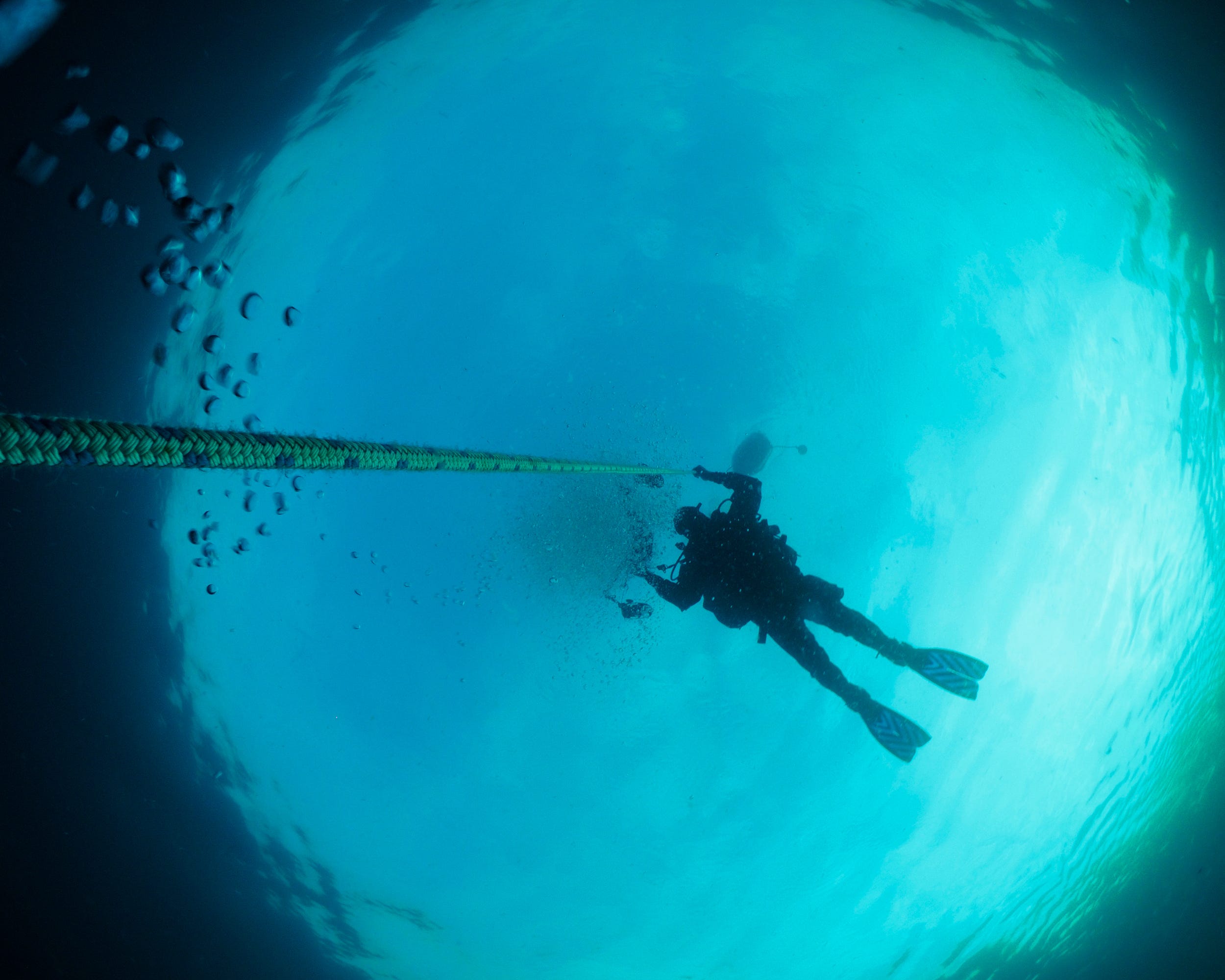
We were the first pair in. The buoy marking the shot line fell from view and rose again on the passing swells as we ran through our checks and rolled backwards into the grey bosom of the Celtic Sea. We finned across to it, exchanged OK and Descend, then turned face down and began to drop, the angled line held loosely in one hand to guide us down. A few metres down I paused to clear my ears, took stock of the moment, and looked back for my buddy — and it was then that the open water made itself felt. This was not the coast. Inshore, around Kinsale and Oysterhaven, our home patch, the sea has one character; out here it had another, colder and more oceanic, and it closed over us as we sank beneath the grey roof of cloud and rain.
Light levels were already low, and lower still as I powered up the camera, the rain front pulling the dusk forward out of a midsummer evening that should have stayed bright for hours yet. The current had not let go. Being first in, we were a little ahead of the slack — that brief pause when the ocean calms its canter before it changes direction, ebb to flood and back again, as it has done since the dawn of time on this ocean world of ours, in answer to its gravitational cousin and nearest cosmic neighbour, the Moon. As we came up on the twenty-five-metre mark a pale shape resolved out of the gloom below us, the first sign of the reef: a white outline, ahead and beneath.
I settled my buoyancy and got comfortable. We had twenty minutes on the bottom before we would need to start back up the line, and we set off into the current by design, so the drift would carry us home when we were ready to turn the dive.
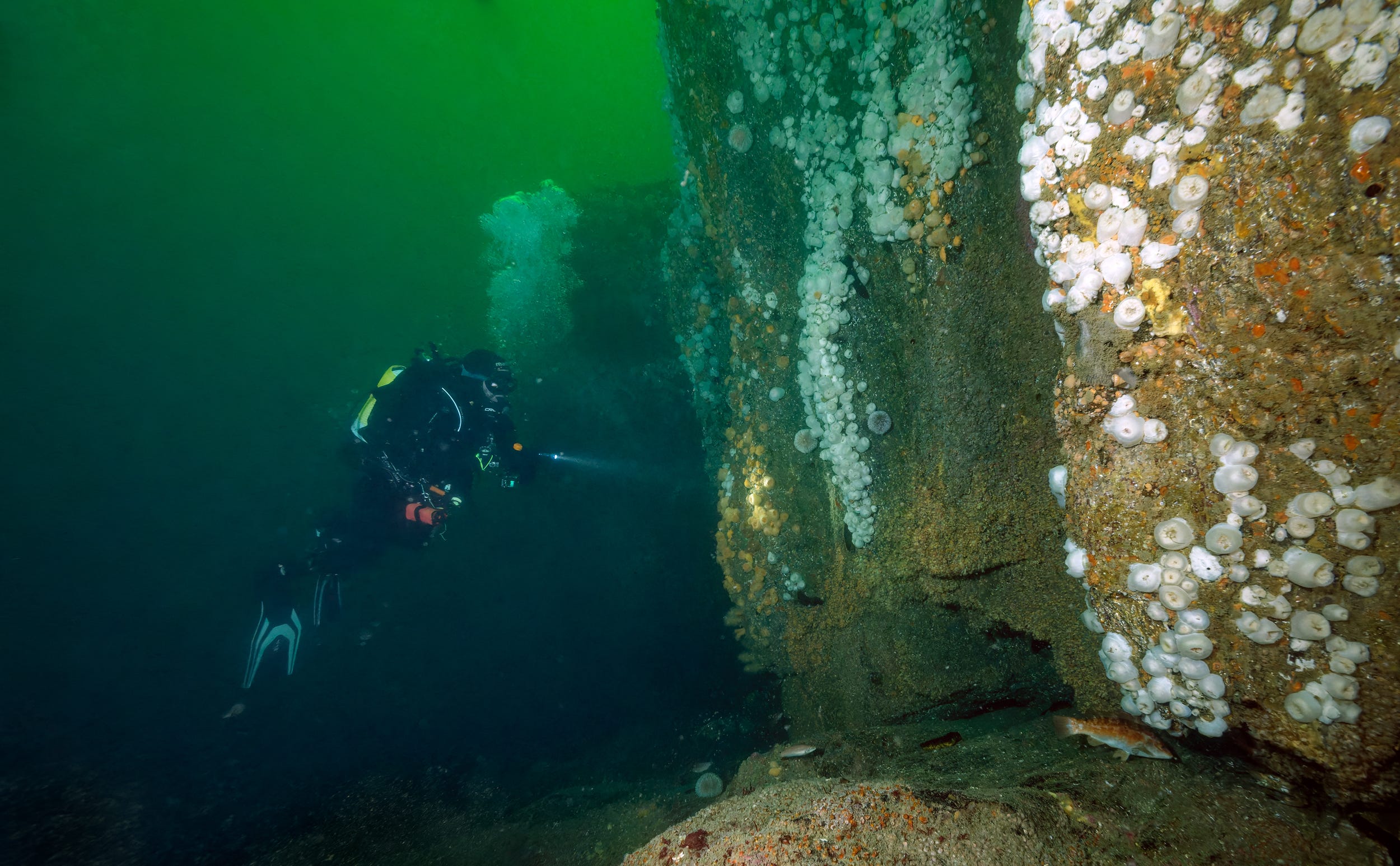
My buddy’s light found the white wall I had glimpsed on the way down. Plumose anemones covered every inch of it, dense and soft and pale, giving way only in patches to darker greens and oranges. In the clefts between the angled rock the shadows held — a pollack, perhaps, hanging back out of the light.
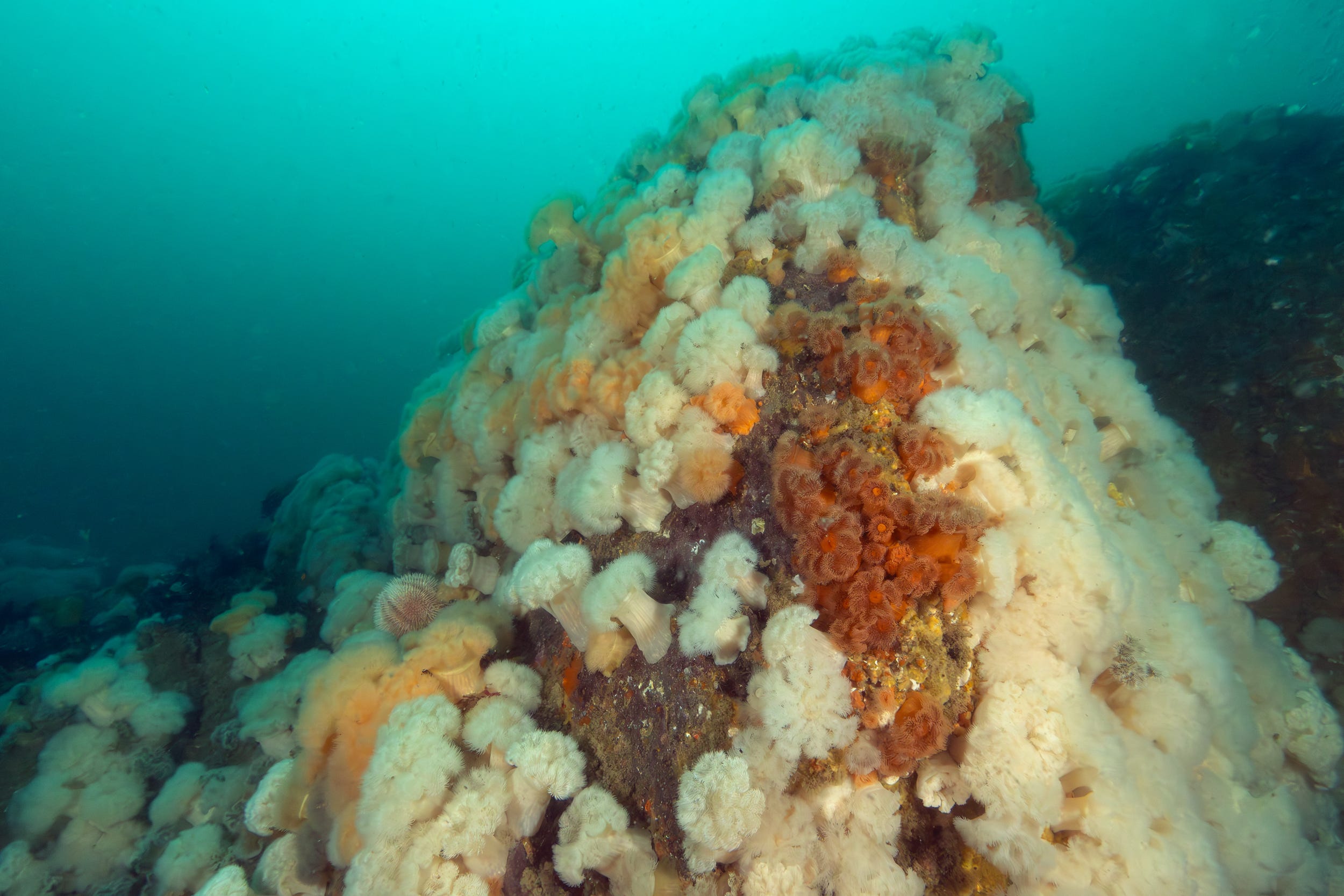
Ten minutes in, we were working entirely by the beams of our dive and focus lights, swimming in among the pinnacles, rising and dropping along faces cut at oblique angles. This is what makes the Lings the most memorable dive on our south coast: not the depth, nor the distance offshore, but the sheer kaleidoscope of colour that opens once you are down among the peaks.
And here is the thing about that colour: it reached us only by the light we carried. By the time we were among the peaks, the water had gone properly dark, the surface a rumour somewhere above, and beyond the reach of our beams there was no colour at all — the deep had taken it. Where a dive light fell, the reef bloomed, a pool of it at a time, shifting as the beam shifted, and the eye gathered it piecemeal, never the whole. The camera gathered more. I had wound the camera’s sensitivity up to a height that would have been unthinkable a few years ago — ISO 3200 — so that with a little light it caught far more than the eye could hold, and handed the scene back to me afterwards on the screen, lit and entire.
The Peaks have been giving things up to people for a long time. To the men who fished them, they gave ling and pollack and conger, and the charter boats out of Kinsale built a reputation on that ground — superb mixed fishing, written up by visiting journalists to draw rods from England and Holland. The records that survive from those years are records of catches: a specimen pollack one season, twelve and a half pounds, named and weighed. The sea gave, and what came up could be put on a scale. We come for the part the scales never measured — the shadow I took for a pollack, the anemones standing open in the current, the colour the camera kept for me. Same rocks; a different harvest.
It was not the day I will remember the Lings by — that day was filmed more than a decade ago and lives now on a screen. But it was a day the Peaks let us come.
When the invitation came again, before the summer had properly settled in, it came in a different key. The forecast promised the opposite of that June evening: bright, calm on paper, force two to three out of the west, the kind of morning that should deliver the Lings at their best. We put out from Oysterhaven expecting a clear day and found fog holding stubbornly along the shore behind us instead — thinning offshore to something like a mile of visibility, enough that boat traffic was no concern, though there is rarely much of that so far out regardless. Normally, at this distance, land drops away almost entirely, or you’re left with a thin grey line of the Old Head on a clear day. That morning it simply wasn’t there.
Going down the line, I found myself reading the water the way the last dive had taught me to, waiting for the blue tinge that means the coast has let go of you. It never came. The green held at ten metres and thickened with depth, gloomier the further down we went — exactly the opposite of what the evening dive had shown me. The one lesson I thought I’d learned from the Lings, they were already taking back.
The first minute or two at twenty-five metres always goes on housekeeping — clearing ears, settling the suit, finding neutral buoyancy — and only then does the diver in me hand over to the photographer: reading what light there is, working the strobes, checking exposure, before switching back again to the discipline of depth, time and gas that never really goes away. There is no free ascent out here; whatever happens on the bottom, you find your way back to the line, because a lone diver’s marker is a hard thing for a boat to spot this far from shore. Two advanced nitrox divers ahead of us had fixed bright strobe lights to the line, five or six metres off the seabed, and it was a comfort to glimpse them even after drifting a little way off.
Back on the boat, we heard the bull seal before we saw him. A laboured breath through flared nostrils carried in the still air, and we turned to see his large head and dark eyes fixed on us. On his last breath, the nostrils shut, the head turned, and the whole bulk of him rolled past, two or three seconds of him, then only the tail, and then nothing. He has shown up on each day out there this season. Whether he had come to check on the two divers already down on the line, neither of them saw him, so there’s no knowing what he saw or sensed from the bubble-blowing visitors to his patch.