


"I'm away to Cootehill for the bus to Cavan", he announced, climbing into the passenger seat before I could ask where he was headed.
"Hop in", I smiled.
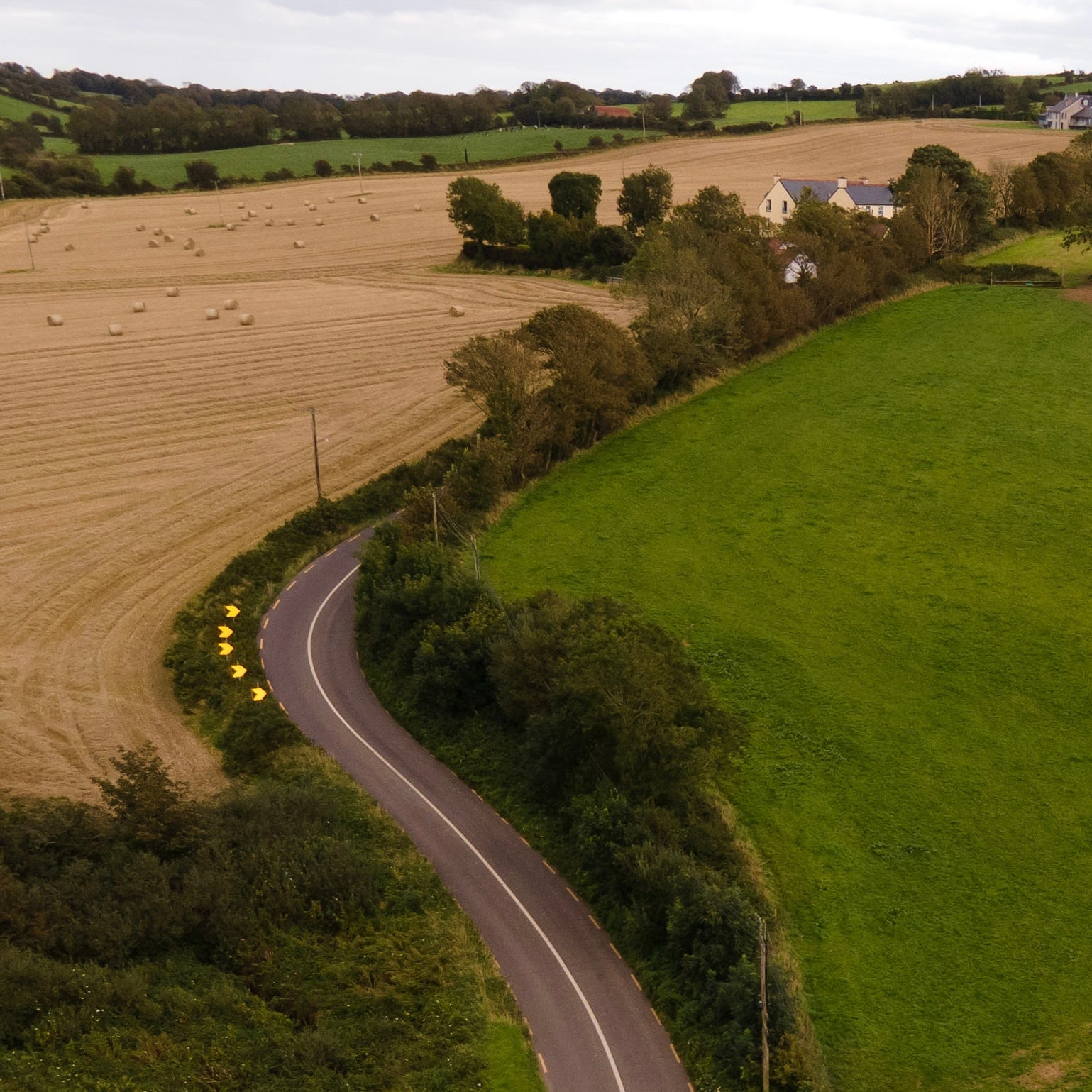
I spotted him on the road ahead, arm outstretched, and thumb enthusiastically stretched skyward. Actually, I saw his bright blue, two-wheeled shopping cart first, which he now manoeuvred between his knees as he settled in. I was driving on the quiet country roads that wind through the rolling drumlins of south Monaghan. As I waited for my new passenger to settle, I noticed the narrow, overgrown laneway, which I presumed led to his home. On his slight frame, he wore a black bomber-style jacket, blue jeans and dusty patent shoes scuffed from many miles of country roads. Large tortoiseshell glasses framed his narrow face, while his weathered skin looked roughly shaven, showing specks of grey stubble that had escaped the razor. An oversized woolly hat perched high on his head kept the morning chill at bay, the extra space on top mimicking a hair bun.
An older man hitching a lift is an unusual sight in modern Ireland. As we have developed motorways with 120-kilometre-per-hour speed limits, hitching has disappeared on our main roads but remains common in rural areas poorly served by public transport. Urban dwellers and drivers overlook those seeking to share some or all of their motoring journeys, possibly because it is rare today. Or, maybe we need to be in a slower, more open frame of mind to be aware of a person on the roadside up ahead, waiting and hoping. It could also be age and life experience that retains an open channel of awareness to someone 'thumbing a lift' – those of us old enough to have done so ourselves being more open to it. As soon as my new passenger settled in, I moved back onto the quiet road; no cars had passed either way in some minutes.
Initially, he stared ahead, enjoying the elevated position of a van seat and the view over the ditches.
"Them sheeps ma' brother-in-laws", he announced loudly to the windscreen.
"It's all sheep in these parts?" I asked.
Silence. A few moments passed before he made a similarly loud declaration.
"Cousin 'a mine used to live up there", he said, his arm raised and pointing directly towards the spot, which happened to be across my vision. I ducked to keep an eye on the road—another pause.
"It's a grand day", I ventured, making my declaration and opening the question to debate. But, glancing over, he stared resolutely ahead, and it dawned on me that he had not heard a word I said.
A childhood memory flooded my mind, its sluice gate opening with the clarity of the crisp morning light. My brother, sister and I were seated on a large armchair at the end of the kitchen-dining area of our 1960s semi-detached home in the then-expanding Limerick city. My parents were chatting with friends over tea while we tried to be 'good'. Our visitors were Seamus and Dolores, and she was the first deaf person I had known as a child.
She had an unusual way of speaking, which caught the attention of my ever-curious younger brother. Her diction was different to ours and was not going to escape investigation.
"Why is she talking like that?" He asked and got an elbow in the ribs from my sister.
"She can't hear; she's deaf. Shut up", she whispered in his ear.
At age 7, my brother spent much of his life beginning every sentence with the word "why?". This beautiful curiosity drove us half mad.
"Why can't she hear?", he promptly asked, true to form.
"Shush", my sister said, trying to contain his expanding questions, now quietly waiting their turn.
"But if she's deaf, she can't hear me", he said, glancing at both of us in turn, the logic flawless.
"She can lip-read", I chimed in. Then, in a rare departure from form, he opened the following question with a 'what'.
"What's lip-reading?" He asks.
"She can tell what you are saying by watching your mouth move", I tell him. His eyes widened further, this superpower demanding further scrutiny. He stared at the adults as a revelation dawned on him.
"I…, he announced, can lip-read", both hands rising simultaneously, index fingers at the ready to plug his ears. My sister and I suppressed giggles as he stared intently at the adults chatting. At least he would be quiet for a few minutes. Dolores was at ease, her glance moving between those around the table, topping up her tea before rejoining the conversation.
"I know what they're saying," the novice lip-reader announced, his fingers still in his ears, his lips moving to the rhythm of the adult chat.
"You can still hear them", my sister says.
"Why is this she deaf?"
Normal service resumed.
"Why does she talk so loud?"
The traffic jam of 'whys' began to move after a long tailback.
Later that day, I spoke with my mum on the phone, telling her about the sudden recollection I thought was long erased from my memory's hard drive. Sometimes, scenes and instances are only moved to the recycle bin and can arise with a suitable prompt.
She told me that Dolores' hearing loss resulted from measles as a young child. While there is a long list of causes of deafness before birth, it is less common in early childhood. Profound hearing loss can occur after mumps, measles or meningitis. I can only imagine that the resources to help a child with hearing loss in the 1940s and 50s in Ireland were probably little to non-existent. Lip-reading, or speech-reading as it is also known, is a skill that comes relatively quickly to children and young adults but can be challenging for some. As babies, we learn our first words by closely watching our mother's mouth, facial movements, and hearing sounds. Speech-reading is a more complete description of a complex skill of looking, observing and making sense of communication in context. Even the often used moniker, the 'third ear', gives the impression of lip-reading being a passive skill. Still, people who are deaf or hard of hearing will tell you it is exhausting to make sense of a conversation using visual clues alone.
As we approached the junction to join the main road to Cootehill, a geographic marker again broke our comfortable silence.
"Aunt o' mine used to live up there", he said, this time thankfully pointing left. He took a long look through the passing trees.
"Jackson... Jackson, she was"as if I might know her.
A few minutes later, we approached the centre of Cootehill, and the traffic naturally slowed.
"I'll get out here", he announced, reaching for the door handle before I stopped. I indicated and pulled in.
"All the best", I said as he manoeuvred the blue shopping trolley to the ground and swung the door closed. I smiled as I saw a mouthed "thank you" that I couldn't hear.
Making my way out of the village, I mused that those who live without sound are the most comfortable with silence. I thought of the beautiful human resilience of navigating through life, developing superpowers to clear hurdles as they arise. And the bus to Cavan.